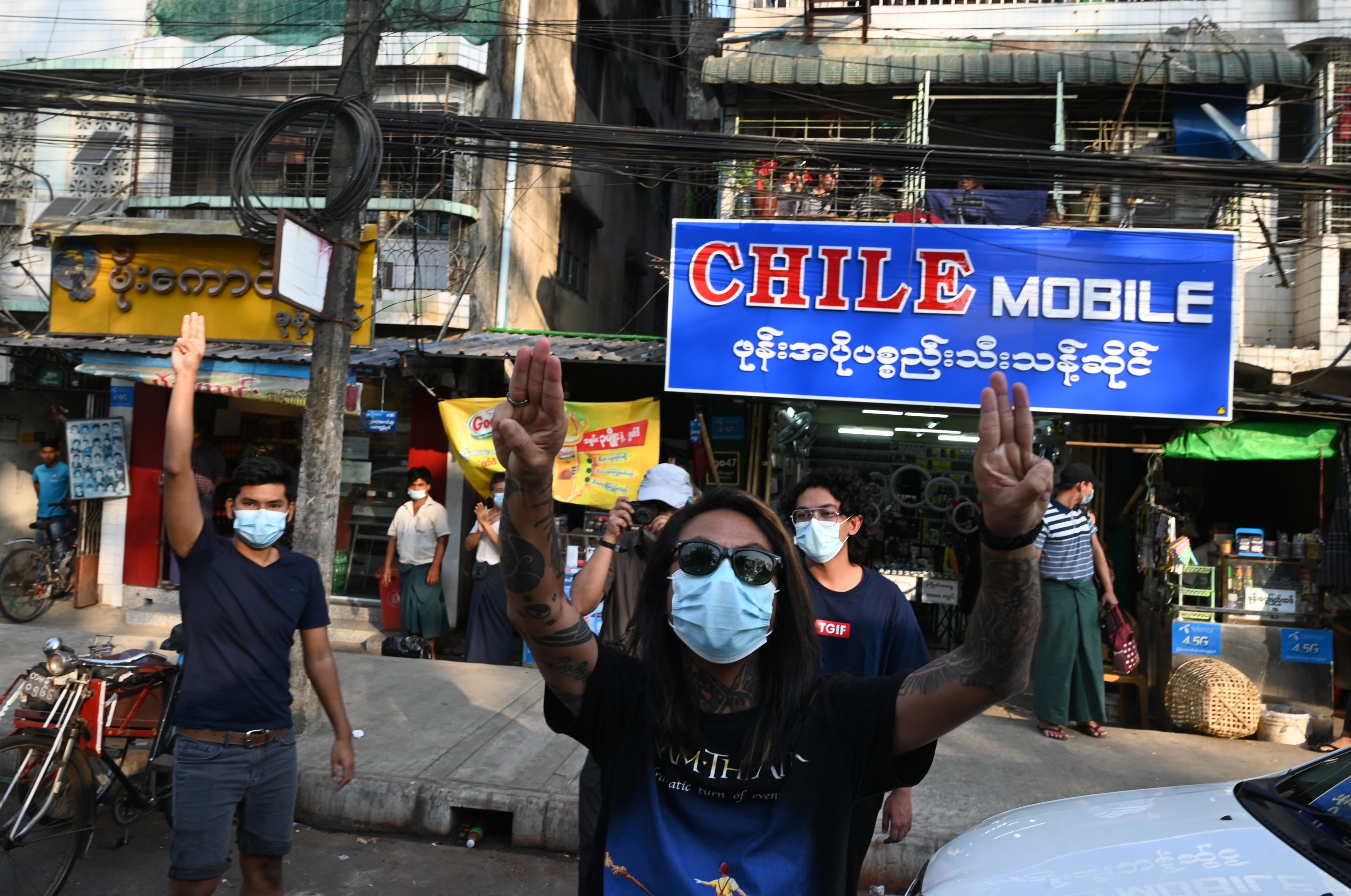
In the dystopian Hunger Games novels by Suzanne Collins and in an adapted series of films, the three-finger salute is a gesture of thanks, respect, gratitude, or to say goodbye to someone to a loved one. The heroine Katniss Everdeen becomes the “tribute” by volunteering to go into the arena to save her younger sister. In lieu of applause for her act, residents of the District flashed the three-finger salute as a sign of respect. Today, the salute is a group rallying cry against oppressive authoritarian rule, evidenced by its usage in Thailand dating back to early 2014, and recently in Myanmar after the February 1 coup by the Tatmadaw that ousted Aung San Suu Kyi and the National League for Democracy (NLD) from power.

People have long used symbolism, creativity and ritual as integral to the formation of group identity. Through acts of theater or gesture, people acting in unison both energize themselves and reinforce group values. The power of rituals and symbols binds a group together and provides a clear agenda for their behavior. Sometimes the symbols capture the essence of horrific moments, such as the self-immolation of a Tunisian street vendor, Mohamed Bouazizi, who became frustrated with the structural injustices or that of Khaled Saeed, who was brutally beaten by police officers in Alexandria, which ignited the 2011 Egyptian Revolution. These events become catalysts for future action. While Thailand had other symbols or signs of defiance, such as small group readings of George Orwell’s 1984, it was the three-fingered salute that resonated the most with the Thai public.
The Hunger Games salute became commonplace early after the May 2014 coup d’état that swept former Prime Minister Yingluck Shinawatra from power. Days after then-General Prayut Chan-o-cha assumed power, protesters began flashing the three-finger salute in defiance. Despite warnings from the junta that demonstrators who violated a ban on gatherings of more than five people would be arrested, people gathered by the dozens to flash the salute and declare their opposition to the coup. To many, the salute transcended its original meaning. Many early on saw the salute as emblematic of the French Revolution, a gesture of liberty, equality and fraternity. Others viewed it as meaning “freedom, election and democracy.”

Symbols are extremely difficult to silence. The junta tried to enforce a ban on public criticism of the 2014 coup by blocking websites, closing television stations, and blocking sensitive images and video. Students got creative, buying out tickets to Hunger Games movies and handing them out to the public. Students also interrupted Prayut himself, flashing the salute during a November 2014 speech before being carried away to a military facility for “attitude adjustment.” Additional attempts to punish dissent and censor public criticism came in the run-up to the referendum on the current Constitution. The regime went through absurd lengths to punish dissent, at one time charging two eight-year old girls for tearing down voter lists—all because they happened to like the pink paper they were printed on.
In Thailand, the three-fingered Hunger Games salute lives on because the resonance of the films to Thais mirrors some of their own realities. The fictional brutal authoritarian regime in the nation of Panem is home to desperate levels of social and economic inequality. The capital city holds sway over twelve other districts through an army of peacekeepers, constant propaganda, and capital punishment. The use of comparable themes of tyranny and economic disparity provides sufficient linkage to modern Thailand, currently the most unequal country in the world which is run by a military-backed government. The attempts to block the salute by the junta only seemed to solidify and legitimize protester calls for democracy and greater equality.

Now, as the spectacle of military theatre and systemic repression has moved from Thailand to Myanmar, another population has adopted the Hunger Games salute. Medical staff in the city of Yangon, dressed in regular protective gowns and wearing facemasks, raised the salute as a gesture of support to Aung San Suu Kyi, who remains under arrest, and a symbol of defiance toward the Tatmadaw. Likewise, in the city of Mandalay, healthcare workers at a coronavirus treatment center flashed three fingers and held up a banner that read, “We support civil disobedience movement.” And like that of the military junta that seized power in Thailand, Myanmar’s generals have sought to crackdown people’s appetite for public protests, blocking access to Facebook, Instagram and Whatsapp. The Ministry of Transport and Communications told telecommunications companies to block social media until February 7 in order to maintain “stability”. Members of the NLD also took part in raising the salute. Win Htein and Kyi Toe flashed the salute along with model Paing Takhon, who posted a photo of himself making the gesture.
However, it is unclear which symbol will win out. People in Yangon have resorted to banging on metal pots in a gesture to drive away bad karma, chanting “evil be gone.” They also beat on drums, rattled pans, and honked their car horns. Homegrown symbols of civil disobedience have appeared before during darker periods in the country’s history, from the 2007 Saffron Revolution to the 1988 order from Sein Lwin for soldiers to shoot pro-democracy protesters. During past military rule, Myanmar’s residents turned off their televisions and their house lights when the nightly broadcast by the military government began, a sign of disgust and rejection. There have been immediate calls from NLD leaders for the public to resist the Tatmadaw coup and engage in acts of civil disobedience. Acts of defiance and the symbols used to mobilize acts of disobedience are only just beginning.